

Durham Strategic Plan Dashboard

Prosperity

Status Indicator:  In Progress |
  On Hold |
  Complete/Ongoing
Initiative: 2.11 Reduce public safety interactions with and improve outcomes for familiar neighbors
Creating a Safer Community Together
Description
From the data and experience, we know that a small number of people can contribute to a larger, disproportionate number of encounters with public safety agencies. A couple of examples highlight this point.
-
Downtown businesses identified a small group of neighbors who they repeatedly had interactions with that made their employees or customers feel less safe. These neighbors, less than 10 total, had been detained in jail dozens of times each over the last year and also had many complex needs – from housing instability to mental health.
-
One neighbor called 9-1-1 over 400 times in a one-month period and had complex needs around substance use that were driving his calls for service. This same neighbor contributed to 155 interactions with DCSD staff.
This initiative will (1) apply data-driven approaches to identify familiar neighbors (FN) with the highest number of interactions with each public safety agency (to include DECC, DPD, DFD, and DCSD); and (2) develop person-centered strategies and collaborations to better address the needs of these neighbors, resulting in a measurable reduction in the number of times these neighbors engage with the Durham Public Safety Portfolio.
Key Measures & Data Analysis
|
The Department of Community Safety (DCSD) analyzed publicly available 2024 data to identify individuals with the highest number of arrests and examine related patterns. DCSD, Durham County Justice Services, and Alliance and Duke University Psychiatry & Behavioral Sciences Department then reviewed how each agency had engaged with these individuals to better understand cross-system interactions. Selected results below: Interactions with detention facility
Interactions with courts
Interactions with Alliance
Interactions with DCSD HEART
Interactions with Duke
Here are 4 noteworthy measures
Through our work, we’ve developed a theory of change: by improving the conditions that create stability across four key domains—trust, documents & benefits, health, and housing—we have a better chance of reducing interactions with public safety systems. The chart below illustrates how long it took one of our long-time neighbors to access support services in each of these areas. 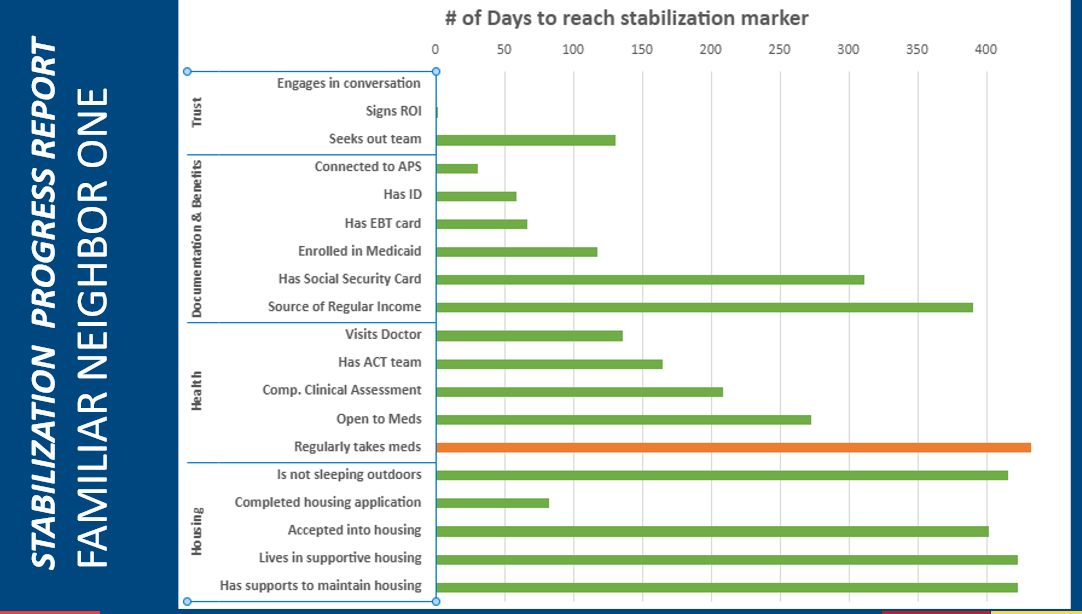
|
|
|
|
Why is it important?
Through a data-driven, collaborative, and person-centered approach, one that engages all public safety agencies as well as health and social service partners, we aim to better address complex, unmet needs that drive disproportionate use of public safety resources.
Additionally, sending first responders to the same home 150 times over a 9-month period is the definition of inefficiency. Having call takers answer a 9-1-1 call for the same person over 400 times in single month is inefficient. Detaining persons over 20 times in a six-month period is inefficient. Figuring out how to better attend to the needs behind these calls can help save time (freeing up public safety responders experiencing significant staffing shortages for other calls), reduce risk and harm (that comes from repeated interactions with public safety they may escalate over time), and may even save money (though it depends on how much public safety costs are fixed versus variable).
What have we been doing?
Staff have continued building and expanding the Familiar Neighbors (FN) program — a cross-agency initiative to proactively support individuals who generate high volumes of 911 calls due to unmet mental health, housing, and social needs. The program has demonstrated meaningful reductions in emergency system utilization.
Key activities include:
• Continuing the pilot with familiar callers and working with partners to understand the cross-system impact of the initiative across public safety, housing, and health systems.
Increased familiar neighbors caseload from 2 at the beginning to 23 neighbors...and counting!
• Completing a Master's-level research project on familiar callers to inform evidence-based program design.
• Exploring the launch of a HUB model pilot for coordinated care and expanding the number of neighbors served.
• Partnering with Durham County, Alliance Health, and Duke Health to explore Psychiatric Street Services
• Building a City/County learning infrastructure including 18 months of biweekly interagency meetings, access to Duke MedLink and HMIS data systems, and participation in a statewide NC learning cohort with Mecklenburg, Guilford, and Wake Counties.
Spotlight: "Purple Martin" went from 23 HEART 911 responses per month to 6 after supportive housing placement. "Green Finch" reduced from 29 to 12 HEART 911 responses and from 95 Emergency Room one year to 12 the next year after program engagement — demonstrating that proactive support paired with housing creates measurable reductions in system utilization.
What's next?
Work to strengthen and scale the Familiar Neighbors initiative will continue through the following activities:
• Medical Consultation Support – Exploring a partnership with Duke Health for clinical consultation on complex familiar neighbor cases.
• Data Sharing Improvements – Continuing to work with Durham County to improve data sharing for familiar neighbors.
• Strategic Alignment – Leveraging lessons from the Familiar Faces initiative and aligning with the homelessness services strategic plan.
• Data Analyst Hire – Onboarding a new data and services integration analyst funded by the Robert Wood Johnson Foundation.
City Website Home Page: Durham, NC | Official Website (durhamnc.gov)
Budget Website Page: Budget & Management Services Department | Durham, NC (durhamnc.gov)
Budget and Management Services Department
Office of Performance and Innovation
Strategy and Performance Division