
Durham Strategic Plan Dashboard

Prosperity




Status Indicator:  In Progress |
  On Hold |
  Complete/Ongoing
Initiative: 1.12 Leverage space-related economic development opportunities
Shared Economic Prosperity
Description
The Fayetteville Street Corridor Improvements Project will mitigate negative social, cultural, economic, and financial impacts that were exacerbated by COVID-19. The project, in partnership with Hayti Promise Community Development Corporation (CDC) and with St. Joseph’s Historic Foundation (SJHF) serving as fiscal agent, will leverage neighborhood-scale, city, county, state, federal, and private investments to accelerate inclusive, equity-centered, and resident-focused strategies that counteract negative economic impacts along the Fayetteville Street Corridor and its adjacent neighborhoods. The project will align and strengthen existing efforts to address the interconnected challenges of wealth inequality, infrastructure shortcomings, and the lasting impacts of COVID-19 on residents and businesses in the Corridor.
Key Measures & Data Analysis
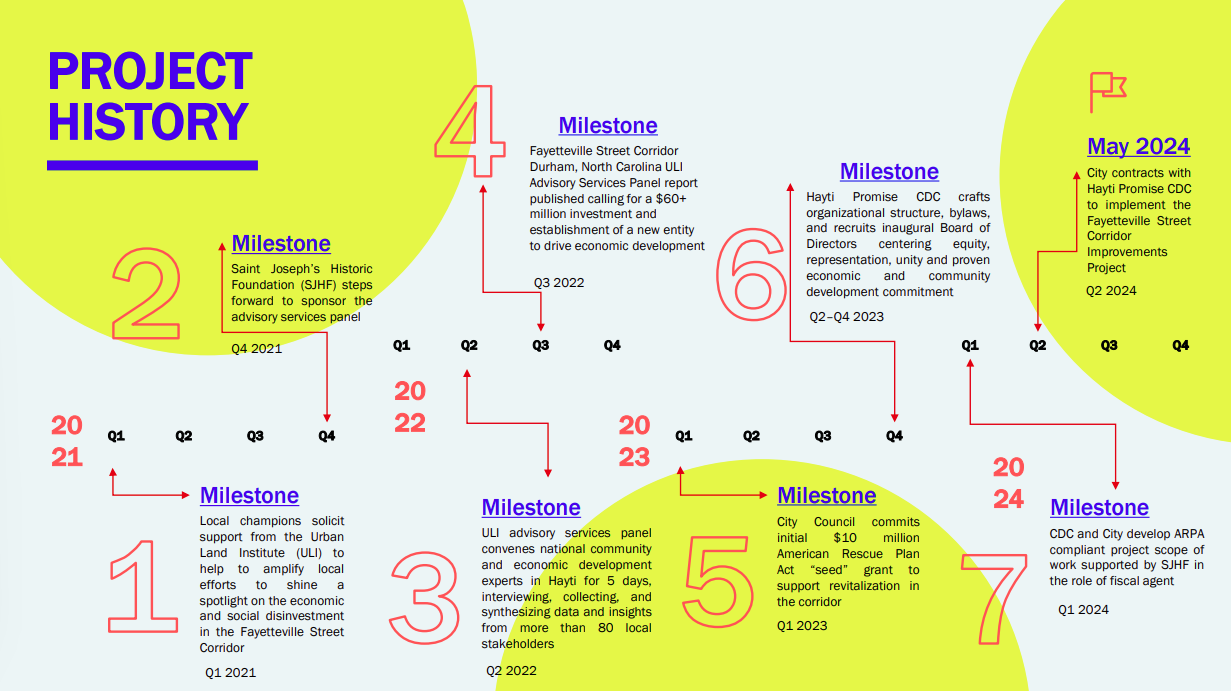
This initiative is ongoing and will have more data in the future. For more information, please check back after our next update. Please visit this link for additional ongoing information: Hayti Promise Fayetteville Street Corridor Project | Durham, NC
Why is it important?
Under the policy of urban renewal, construction of NC Highway 147 (the Durham Freeway) in the 1960s effectively dismantled the once thriving Hayti community. According to a 2022 report by the Urban Land Institute (ULI), the Fayetteville Street Corridor is a spine through the middle of Durham, and the Hayti District, the historical location of many of Durham’s Black-owned businesses and the hub of Black economic activity. The Fayetteville Street Corridor is a gateway that remains vital to the economic development of Durham and the preservation of Black history and culture.
What have we been doing?
- Staff have supported Hayti Promise Community Development Corporation (HPCDC) to advance economic development through place-based strategies and community wealth and capacity-building in the Fayetteville Street Corridor (FSC) project area leveraging the proven expertise and operational infrastructure of local, state, and national community development partners.
Key activities include: - Advancing HPCDC's 3-Year Strategic Plan, Organizational Development, and Brand — placing the CDC on a maturer operational footing.
- Sponsoring paid youth service-learning opportunities including the Hayti Promise Youth Corps lead by Conservation Corps North Carolina, and Hayti’s very own HOPECrew, a signature program of the National Trust for Historic Preservation.
- Launching the FSC Stabilization Partnership and FSC Beautification Initiatives to combat high costs to public health, generational wealth, and local taxpayers, driven by a disproportionate number of Vacant, Abandoned, and Deteriorated (VAD) properties — empowering private property owners to contribute to restoring the physical and economic vitality of the corridor.
- Developing a Main Street Economic Strategy to anchor long-term community wealth to residents, and support existing and new businesses — creating viable pathways to put newly Stabilized and Beautified commercial properties to productive economic use.
- Honing Community Resiliency Initiatives with Central Pines Regional Council offering cost-saving green energy improvements and accessible property taxation and legal assistance, leveraging trusted local service providers like Durham’s own Land Loss Prevention Project.
What's next?
Building on current revitalization and economic development momentum will continue via the following activities:
• HPCDC Fundraising and Operational Resilience – Securing investments that support long-term organizational sustainability and sustained FSC revitalization and advocacy prowess.
• Community-Driven Placemaking – Arming local Faith-Based Entities, neighboring non-profits, and small businesses with the skills, resources, knowledge and collective motivation (community capacity) to activate dormant spaces, build service enterprises, and deliver services and experiences that tap latent economic potential via potential drivers like NCCU, preservation tourism, and greater residential density.
• Partnership Pipeline – Continuing to seek and solidifying partnerships that solve problems and fill resource gaps for residents, including a potential Community Design Center collaboration with NCCU, Wi-Fi connectivity hubs with Durham Digital Inclusion, power pole clean-up with Duke Energy, or destination signage sponsorships with new philanthropic investors.
City Website Home Page: Durham, NC | Official Website (durhamnc.gov)
Budget Website Page: Budget & Management Services Department | Durham, NC (durhamnc.gov)
Budget and Management Services Department
Office of Performance and Innovation
Strategy and Performance Division